
16 October 2026 · 5 min read
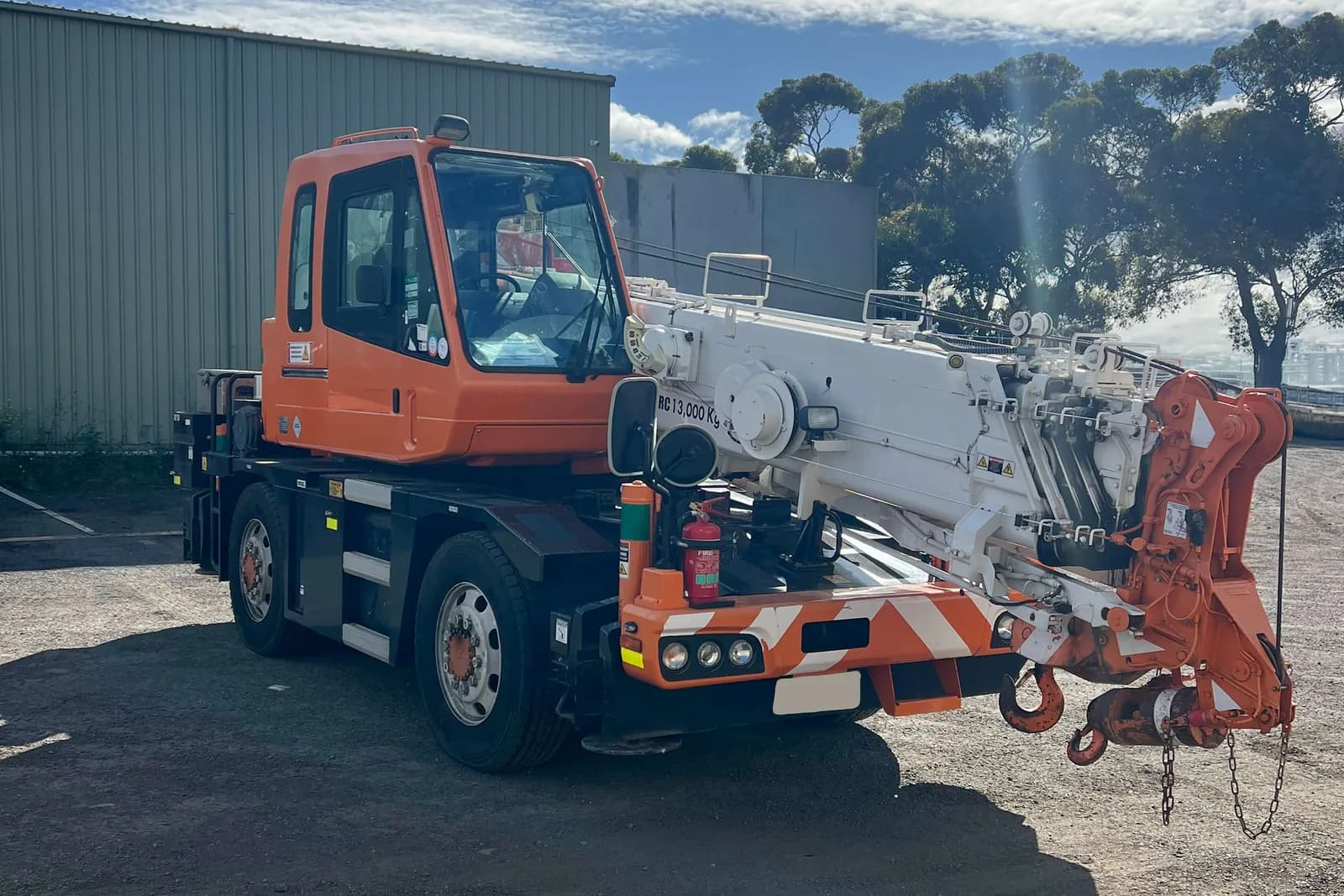
Choosing a crane starts with the job, not the machine. The weight of the heaviest load, how far it has to travel from the crane, the ground the crane will stand on, how it gets to site and how often it moves once it is there all point towards a different type of crane.
Below we compare the crane types we buy, sell and hire most often, what each one does well, where it falls short and the projects it is usually bought for. Capacities quoted are typical ranges only. The load chart for the specific make and model always has the final say.
At a glance
The table summarises how the main crane types differ. Each one is covered in more detail further down.
| Crane type | Gets to site | Ground it suits | Best for |
|---|---|---|---|
| All terrain | Drives on public roads | Prepared and unprepared | General construction, civil and industrial lifts where the crane moves between jobs often |
| Rough terrain | Usually transported on a float | Rough, unprepared ground | Mining, civil works, resources projects and long stays on one site |
| Crawler | Transported in pieces and assembled | Soft or uneven ground, on tracks | Heavy lifts, long projects, piling and lifting while moving |
| Truck | Drives on public roads | Prepared, firm ground | Quick in-and-out lifts on sealed sites |
| City class | Drives on public roads | Prepared ground in tight spaces | Inner-city and confined sites |
| Pick and carry | Drives on public roads | Firm ground | Moving loads around a site without outriggers |
| Mini crawler | On a trailer or tray | Indoors and tight outdoor spaces | Glazing, building interiors and restricted access |
| Tower | Erected on site | Fixed foundation | High-rise and long-duration building projects |
All terrain cranes
An all terrain crane combines road-going travel with off-road ability. It drives to site under its own power at road speed, then uses all-wheel drive and multiple steering modes to position itself on rougher ground. Sizes range from compact units to large multi-axle machines rated in the hundreds of tonnes, with telescopic booms that can be extended further with fly jibs.
That versatility is the selling point. An all terrain crane can do a lift in the morning and be on the road to the next job in the afternoon. The trade-off is cost and complexity: more axles, more drive and steering components and more to maintain than a simpler machine.
- Suits: hire companies running many short jobs, general construction, civil and infrastructure work, industrial maintenance.
- Less suited to: long stays on very rough ground, where a rough terrain or crawler crane is often more economical.
Rough terrain cranes
Rough terrain cranes sit on two axles with large tyres, high ground clearance and several steering modes, so they move easily around unprepared, uneven sites. Capacities run from around 20 tonnes to 145 tonnes and beyond.
They are not built for long road trips and are usually floated between sites. Once they arrive, they tend to stay. That makes them a strong fit for mining, resources and civil projects that run for months, and a common choice for dry hire on those jobs.
- Suits: mines, civil and infrastructure projects, resources construction, long-term site cranes.
- Less suited to: work that needs frequent moves between sites on public roads.
Crawler cranes
Crawler cranes run on tracks rather than wheels. The tracks spread the machine’s weight over a large area, which gives excellent stability on soft or unprepared ground and lets many crawlers travel with a load on the hook. They range from smaller telescopic crawlers through to lattice boom machines, with some used models able to lift 1,000 tonnes and more.
The cost of that capacity is mobility. Larger crawlers are transported in sections and assembled on site, so they suit long projects where the crane can stay put. Telescopic crawlers close some of that gap, with quicker set-up and the ability to work in tighter areas.
- Suits: heavy lifts, bridge and infrastructure work, wind and energy projects, piling, early-stage works on soft ground.
- Less suited to: short jobs where transport and assembly time outweighs the lift.
Truck cranes
A truck crane is a crane mounted on a truck chassis, usually with a telescopic boom. It carries its own counterweight and drives straight onto site, so it can set up and start lifting quickly.
Truck cranes are at their best on firm, sealed ground. They do not have the off-road ability of an all terrain or rough terrain crane, but for straightforward lifts on prepared sites they are economical to buy and run.
- Suits: deliveries and placements on sealed sites, HVAC and plant installation, general construction lifts.
- Less suited to: soft or uneven ground.
City class cranes
City class cranes are compact mobile cranes built for restricted urban sites. A short chassis and all-wheel steering let them get down ordinary streets and into tight spaces, while the boom still gives useful reach. Most lift under 25 tonnes.
- Suits: inner-city construction, building maintenance, confined commercial sites.
- Less suited to: heavy lifts and rough ground.
Pick and carry cranes
A pick and carry crane lifts a load and drives with it, without putting down outriggers. Most use an articulated frame, steering through the middle of the machine, which makes them very manoeuvrable. They drive on public roads between jobs and are widely used across Australia, where the Franna name has become shorthand for the whole category. Capacities typically reach up to around 55 tonnes.
- Suits: moving materials around a site, steel erection, precast placement, maintenance shutdowns, short local jobs.
- Less suited to: long-reach or very heavy lifts that need a fully rigged mobile crane.
Mini crawler cranes
Mini crawler cranes, often called spider cranes, are compact tracked cranes with fold-out outriggers. They fit through doorways and into spaces no other crane can reach, and can lift up to around 10 tonnes depending on the model.
- Suits: glazing and facade work, lifts inside buildings, restricted-access residential and commercial sites.
- Less suited to: heavy or long-reach lifts.
Tower cranes
Tower cranes are erected on a concrete foundation and climb with the building. They offer height and reach that no mobile crane can match on a high-rise site, but they take time to erect and dismantle, so they suit projects measured in months or years rather than days.
- Suits: high-rise residential and commercial construction, long-duration building projects.
- Less suited to: anything short term or spread across multiple sites.
How to narrow down the right crane
Work through these questions before you start comparing machines. The answers usually rule out most crane types quickly.
- What is the heaviest load, and at what radius does it need to be lifted?
- What is the ground like where the crane will stand and travel?
- How does the crane get to site, and how often will it move once it is there?
- How much space is there for the crane, its outriggers and its counterweight?
- How long is the job, and is buying, hiring or a mix the better option?
Talk to the team
All Cranes has been buying and selling cranes across Australia since 1995. If you are weighing up crane types for a project or a fleet, call us on (07) 3180 2870 and we will help you match the machine to the work, whether that is a used crane from stock, one we source through our network, or a dry hire unit.